ELERA VTERM
Inject POS transactions into ELERA.
REDList Solutions built ELERA VTERM to give retailers and partners a controlled way to push transactions into the ELERA POS platform. Customers can submit a complete JSON basket in one call or instrument the transaction lifecycle themselves through a client-driven Cart API.
That makes VTERM a practical fit for online ordering systems, smart carts, and other external applications that need ELERA to remain the system of record for totals, tender, receipts, and submitted transaction data.
What VTERM enables
VTERM sits between an upstream client and ELERA POS, using ELERA APIs to create, advance, and finalize transactions while returning a stable response model that integrators can work with directly.
Basket ingestion
Submit one JSON payload containing the basket contents and let VTERM execute the ELERA ring, payment, completion, submission, and receipt retrieval path.
POST /api/v1/baskets/consume
Returns totals, lines, payments, transaction IDs, warnings, and ELERA steps
Client-controlled cart flow
Start a cart, add items one event at a time, inspect live state, and finalize later when the shopper or external system decides it is time to close the sale.
POST /api/v1/carts creates the VTERM cart session
POST /api/v1/carts/{cartId}/items appends items to the ELERA order
Stable integration feedback
Every response surfaces the furthest completed ELERA stage, the current order state, authoritative totals, and any warnings that explain why a flow is partial or blocked.
Status values include
COMPLETED, PARTIAL, and FAILED
Finalization states reveal whether the order was created, tendered, submitted, cancelled, or blocked
Rendered receipt output
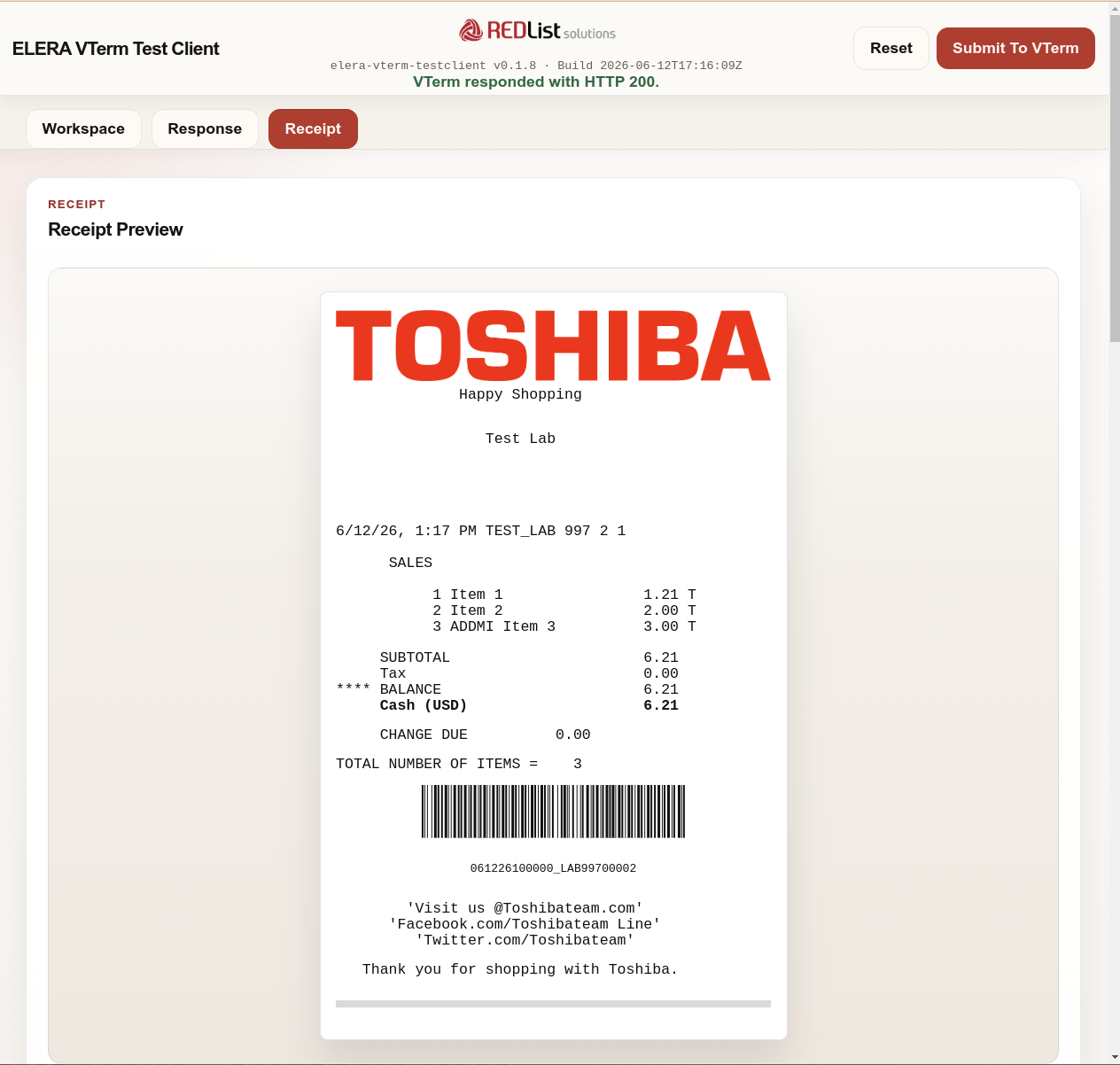
When ELERA returns rendered receipt content, VTERM preserves it so operators and partner teams can verify the receipt that corresponds to the injected transaction.
Structured receipt summary is always returned
Rendered receipt HTML and CSS are included when available
Two API surfaces for different client behaviors
The VTERM API supports both “submit the whole order now” and “behave like a register over time” integration styles without changing the downstream ELERA transaction target.
JSON Basket API
For eCommerce and order aggregation flows
The basket API accepts a JSON file containing basket contents, wraps the ELERA store context, and drives the transaction through ring, tender, submit, and receipt handling in one request.
Ideal for online ordering systems that need to inject a completed digital order into ELERA POS
Supports store, basket, payment, and finalize flags in a single request payload
Returns order IDs, transaction IDs, totals, receipt data, warnings, and orchestration trace details
Cart Lifecycle API
For smart carts and event-driven devices
The Cart API keeps the client in charge of each transaction step. VTERM starts the cart, creates the ELERA order on first item add, and preserves a live in-memory cart snapshot until the client finalizes or cancels.
Supports Start Cart, Get Cart, Add Item, Finalize, and Cancel routes
Uses unique
clientEventId values for idempotent replay of mutating actions
Fits smart carts, scan-as-you-shop tools, and other systems that “inject” each POS event at their own pace
Prospective Customer Fit
Built for real transaction-injection use cases
Online eCommerce ordering systems can push completed baskets into ELERA. Smart carts can ring items incrementally and finalize only when the shopper is ready. Both paths keep ELERA at the center of transaction, receipt, and POS state management.
Current v1 constraints
The current VTERM implementation is intentionally focused and stable. The scope today is enough to validate injection workflows end to end while keeping the contract clear for customers and partners.
Transaction profile
VTERM currently operates with a constrained tender and currency profile in order to keep the ELERA path predictable.
Currency is currently
USD
Payment profile is CASH_USD / CASH
Cart mutation model
The Cart API is designed for progressive item addition and deterministic replay rather than full line editing.
Add-only item mutation in v1
No line void or remove-item route in the current release
Session model
Cart state is held in memory by VTERM, which is enough for lab validation and controlled integration work.
Clients must retain the returned
cartId
Clients should finalize or cancel before cart expiry
VTERM Test Client
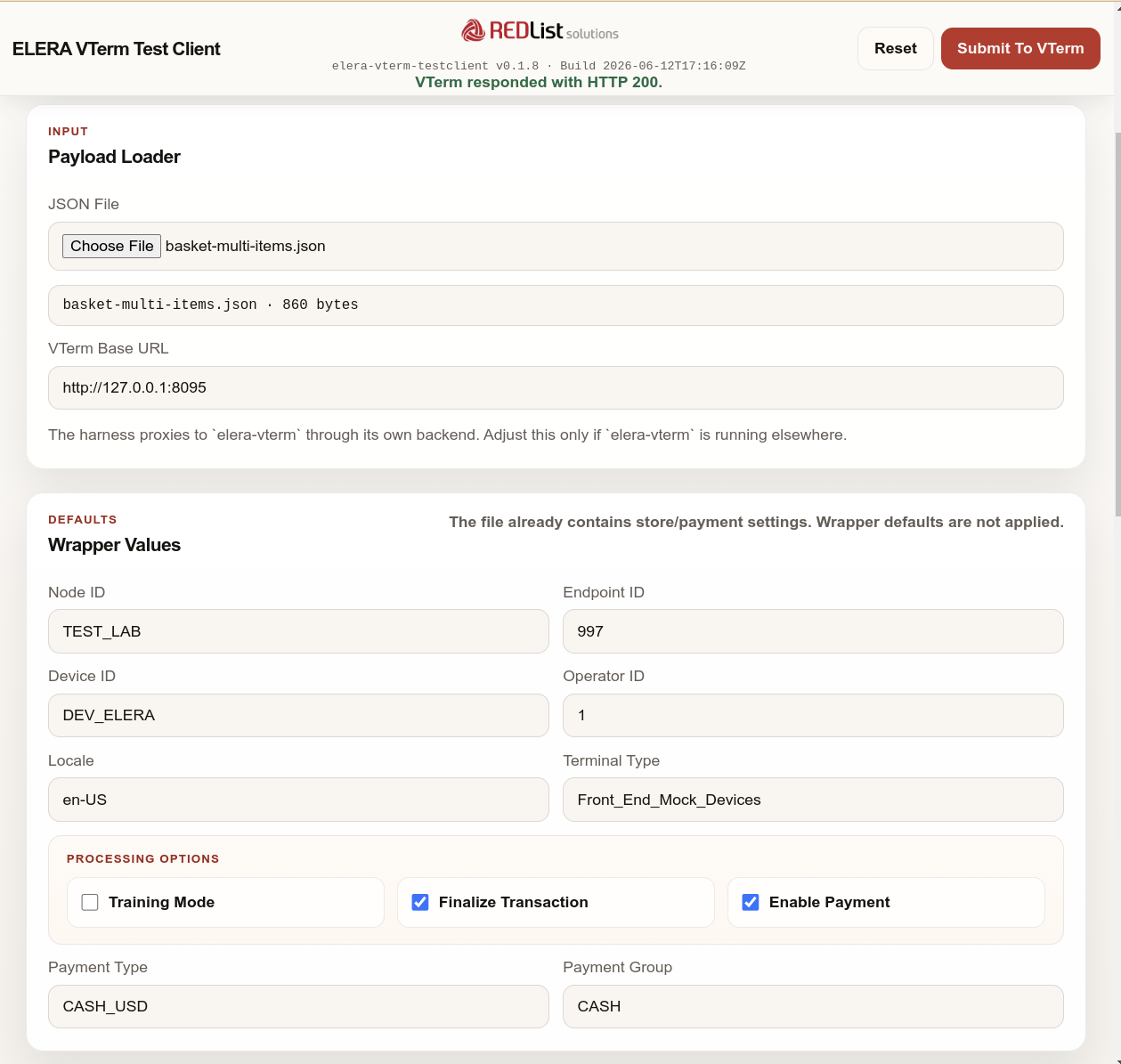
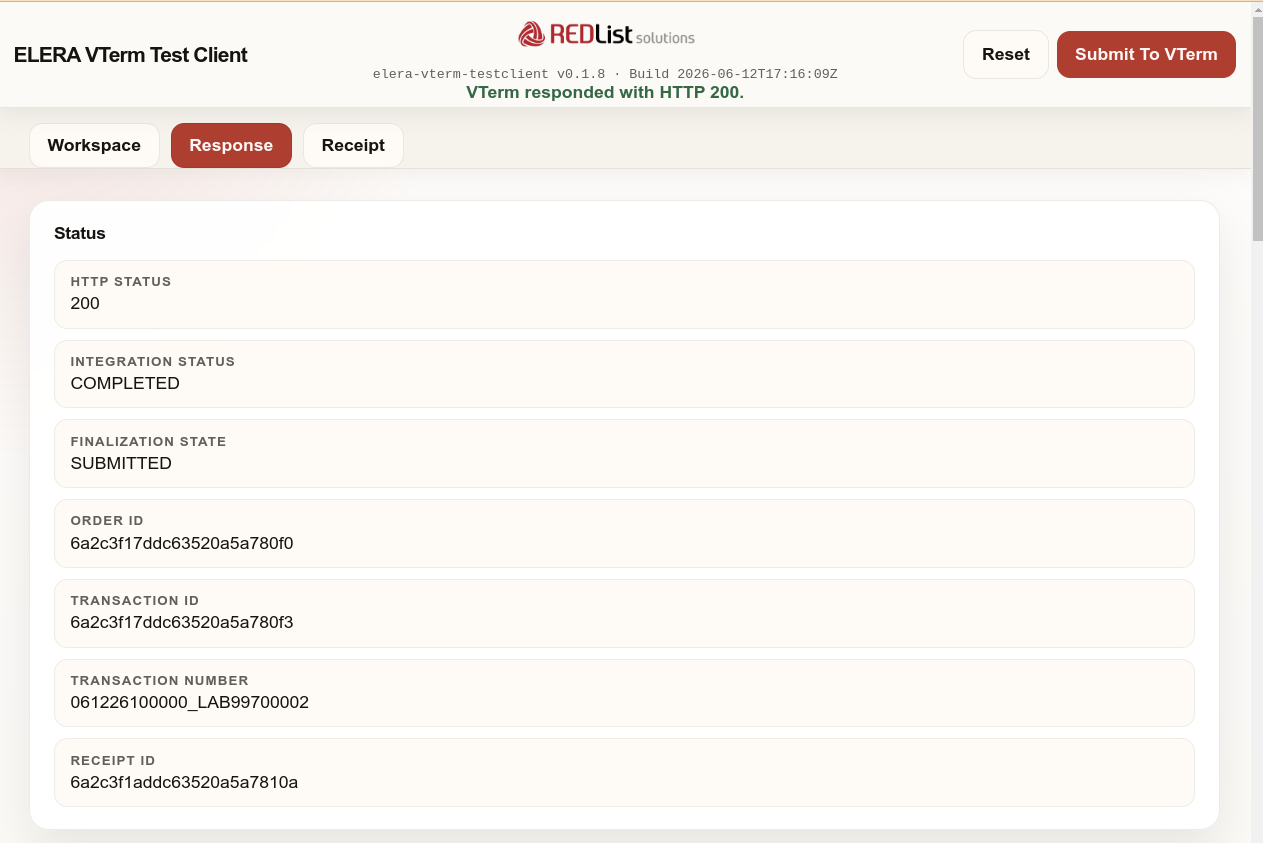
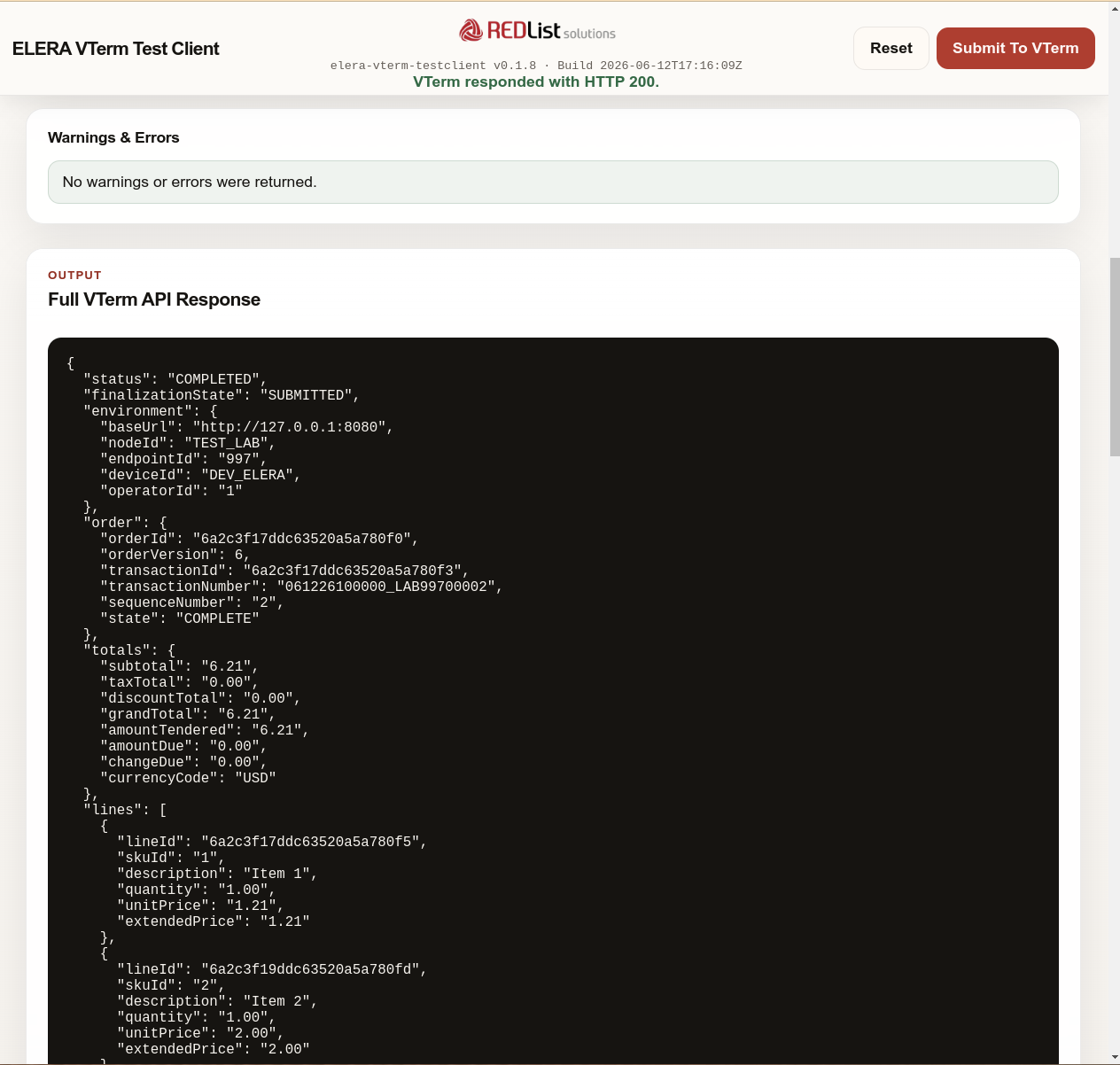
The VTERM Test Client is a lightweight browser harness for the JSON basket API. It loads a file from disk, detects whether it is a full VTERM request or a bare basket payload, applies wrapper defaults when needed, and renders the resulting ELERA receipt response.
What the client validates
Disk-loaded JSON basket payloads for eCommerce-style transaction injection
Resolved VTERM request preview before submission
Full VTERM response JSON, totals, status, and rendered receipt output
Why it matters
For customer demos and early integration work, the harness gives teams a direct way to prove that a candidate basket can be consumed by VTERM and reflected back as a submitted ELERA transaction.
VTERM Cart Test Harness
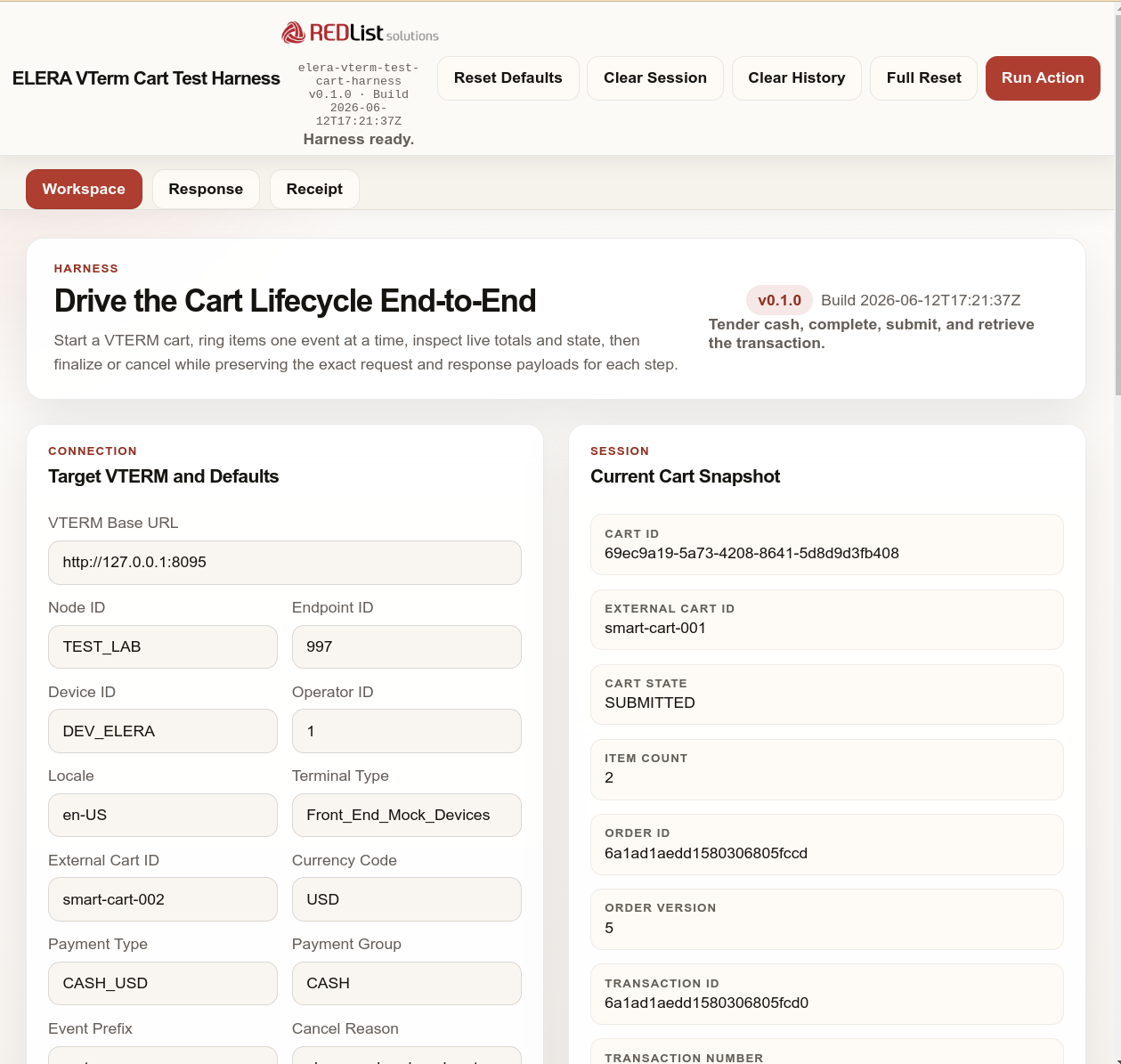
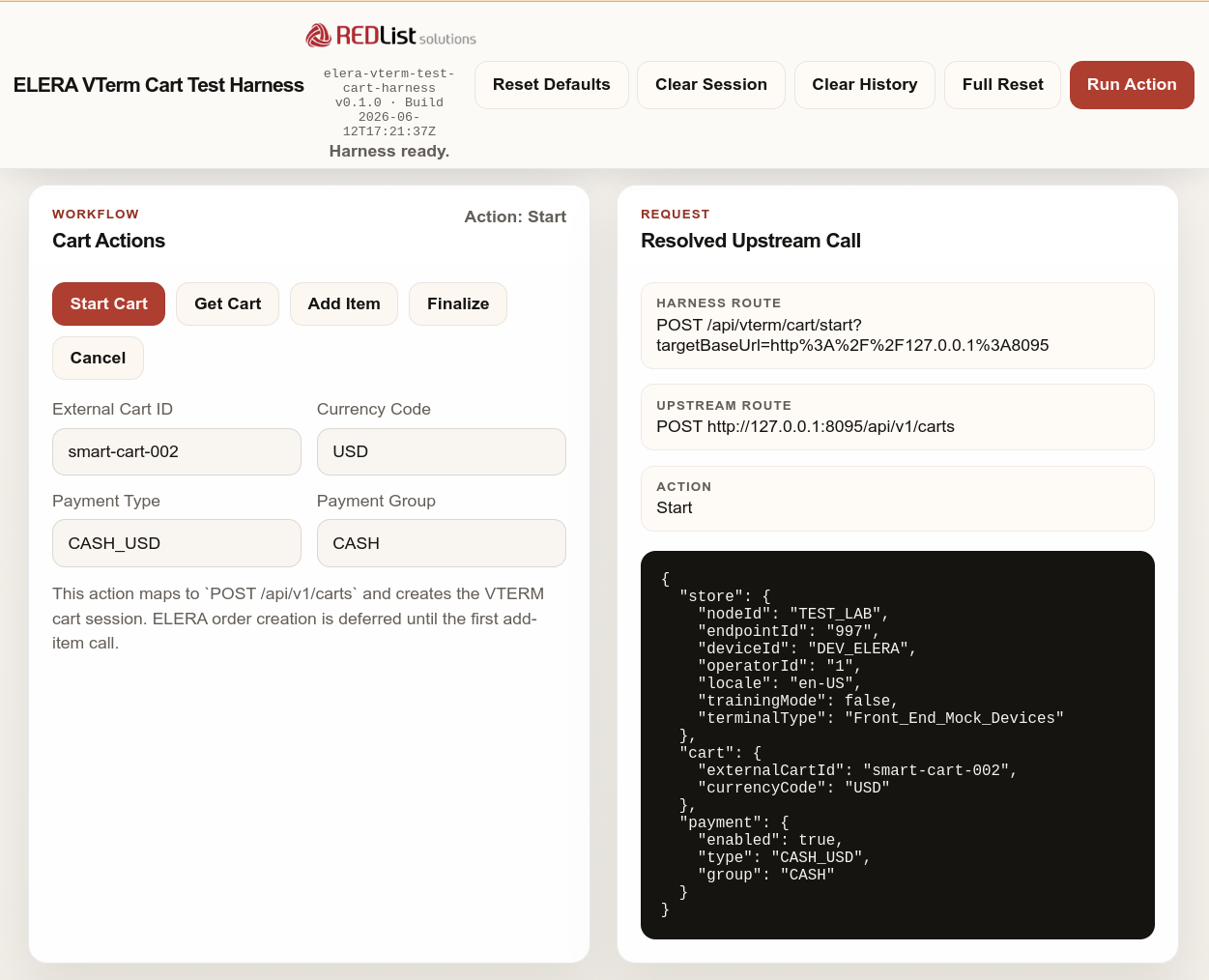
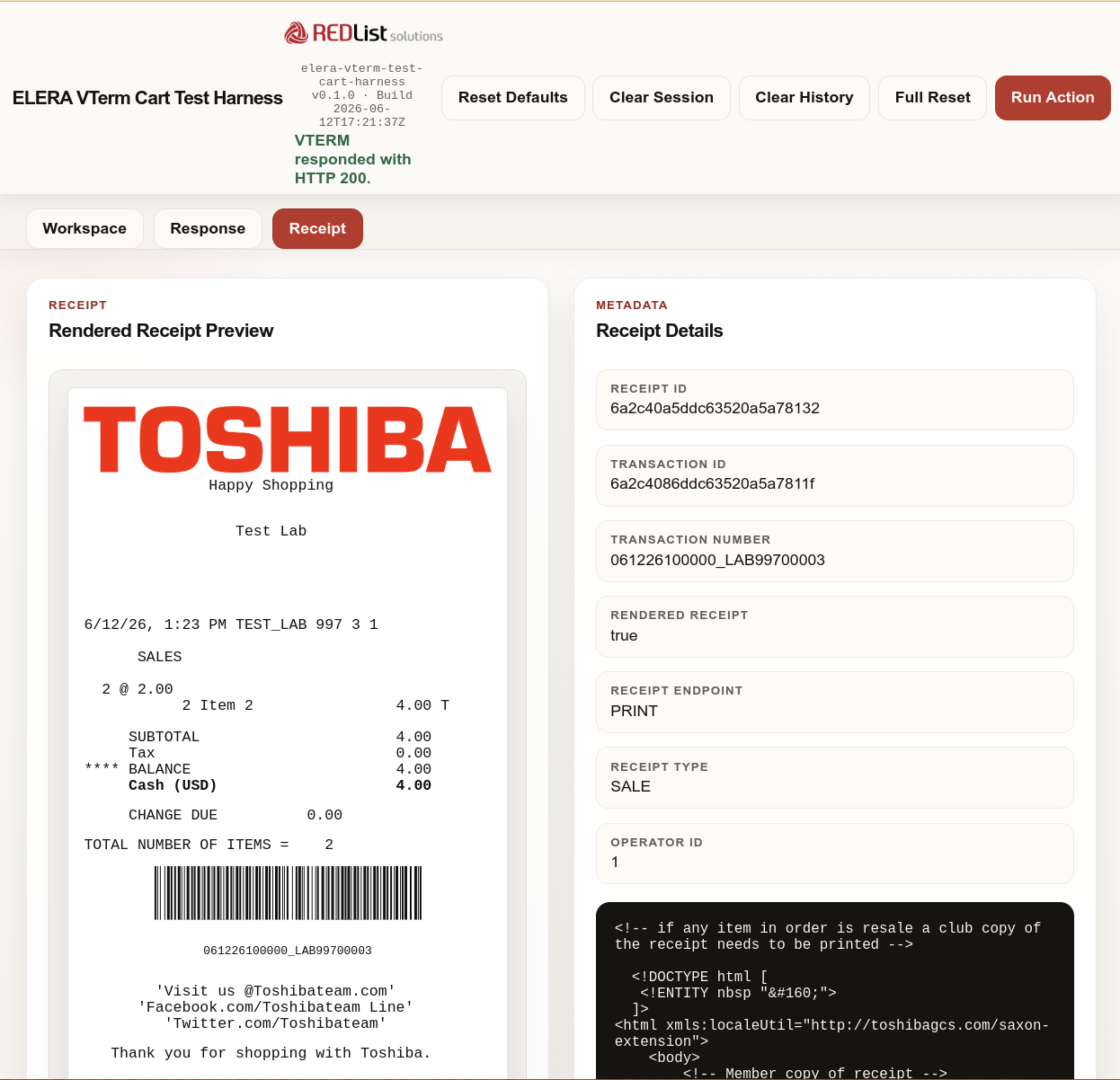
The cart harness is a workflow-first browser console for the VTERM Cart API. It tracks the active cart session, shows the exact upstream request body for each step, persists state in the browser, and makes it easy to validate cart lifecycle behavior end to end.
What the harness demonstrates
Start Cart, Get Cart, Add Item, Finalize, and Cancel against VTERM
Resolved upstream route, method, and request JSON for every action
Session snapshot, recent request history, full response JSON, and rendered receipt preview
Why it matters
This harness is the clearest demonstration of how a smart cart or other event-driven client can instrument the POS flow at its own discretion while still relying on ELERA for authoritative transaction state.
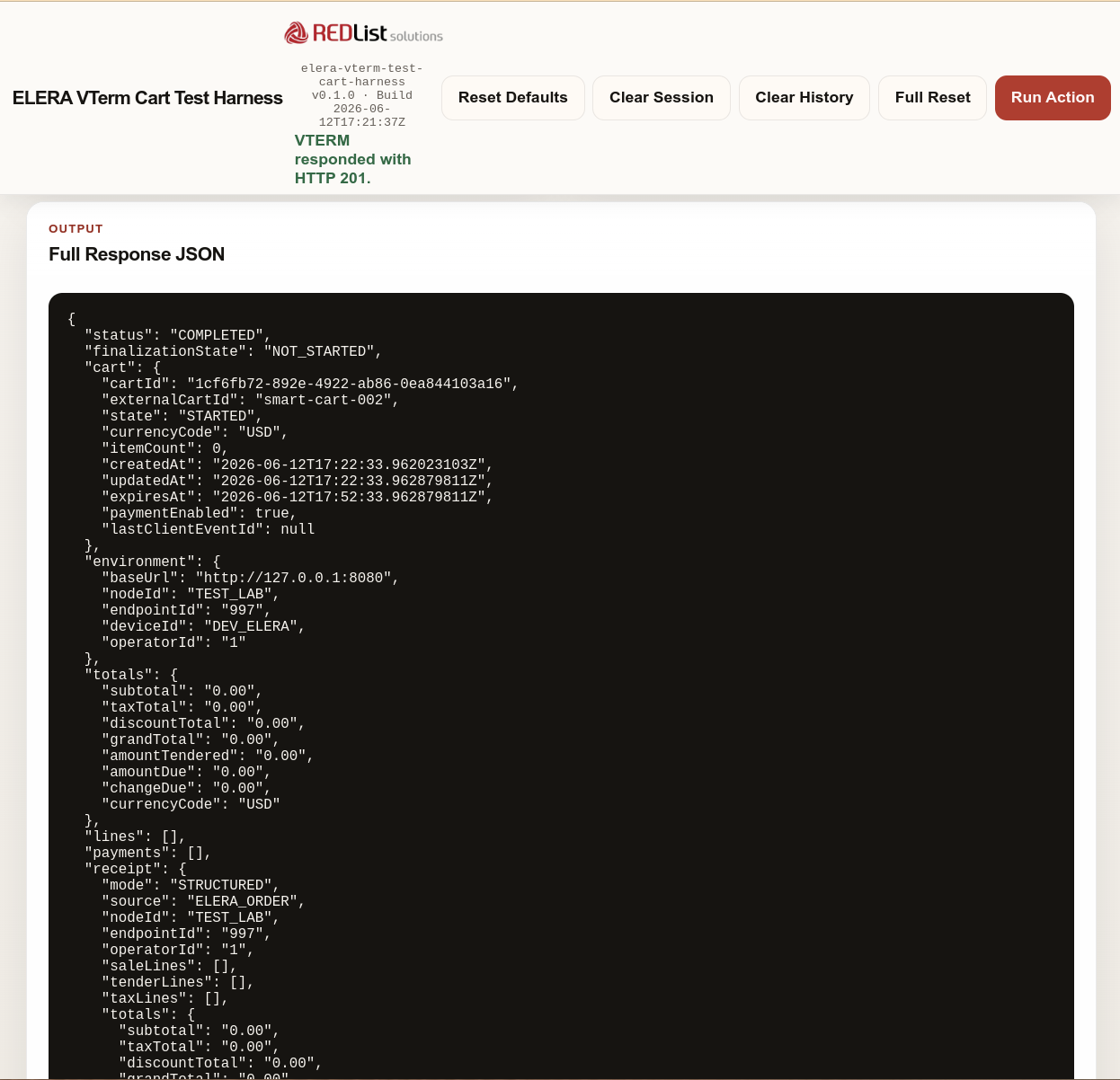
cartId, initial cart state, totals, and the full response payload returned by VTERM.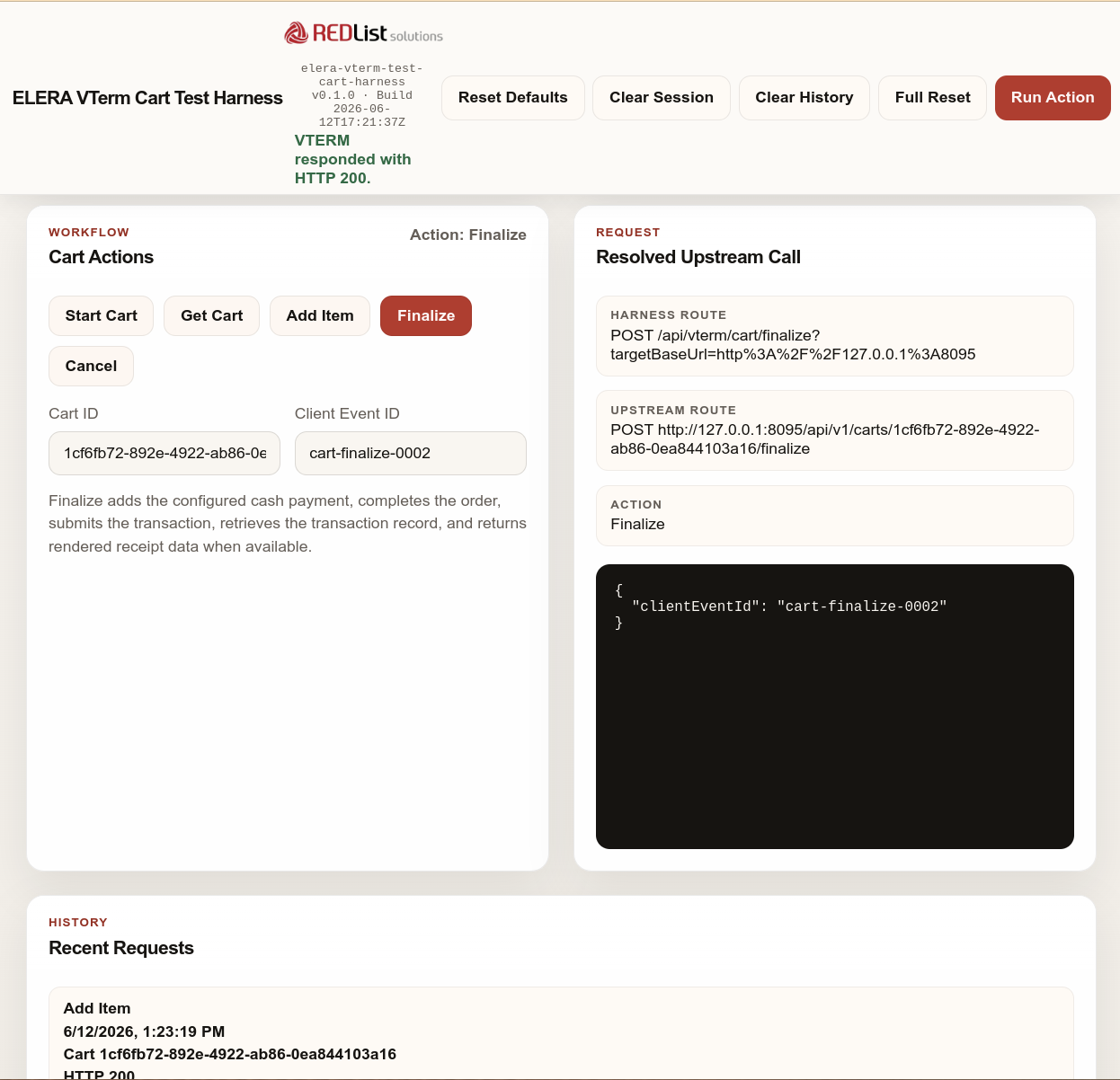
Need ELERA transaction injection for a customer workflow?
REDList can help evaluate whether the VTERM basket API, the Cart API, or a broader ELERA integration path is the right fit for your eCommerce, smart cart, or partner-driven transaction flow.